
Trying to Conceive? The Cortisol Connection You're Probably Missing

Foundational chiropractic care, built around real life.
You've been trying for a while.
Maybe six months. Maybe a year. Maybe closer to two, or three. Long enough that "trying to conceive" has taken over a whole part of your life. Long enough that you've become fluent in cycle-tracking terminology, luteal phase length, and the specific loneliness of a two-week wait.
You've done the labs. Everything looks "normal." Your cycles are technically regular. You've maybe seen a reproductive endocrinologist. You've maybe been told you have "unexplained infertility" — a phrase that always struck you as spectacularly unhelpful, because if it were truly unexplained, someone would presumably be looking harder.
If that's where you are, this post is for you. Not to add another thing to your list. Not to blame stress for your fertility struggles — which, if you're anything like the women we see, you've been implicitly blamed for enough already. But to introduce a piece of the picture that often doesn't get named in fertility appointments, even good ones.
We are not going to tell you that you need to relax. We are going to talk about something more specific — what a chronically activated nervous system does to the systems that govern fertility, and why supporting that layer might genuinely matter to your journey.
When Nothing's "Wrong" But Nothing's Working
If you've been in this stretch of trying to conceive for any length of time, you know a specific kind of frustration. Everything on paper says you should be pregnant. Your cycles show up when they're supposed to. Your labs come back within range. Ultrasounds look fine. Your partner's numbers check out. Every individual data point is unremarkable. And still, no pregnancy.
At some point in this process, a lot of women receive the diagnosis of "unexplained infertility." It's meant to be honest — the standard tests didn't identify a specific issue. But for the person receiving it, it can feel dismissive. What it often means, translated, is "we've ruled out the things we know how to test for, and we don't have a next step."
That gap between "nothing is wrong on paper" and "nothing is happening in reality" is where a lot of women get stuck. It's also where the conversation we want to have becomes relevant — because there's a layer of physiology that doesn't show up on the standard workup but has real effects on the systems that govern conception.
What Cortisol Actually Does
Cortisol is a hormone. It's produced by the adrenal glands, and its job is to help your body respond to demand — whether that's a physical threat, an emotional challenge, a busy work stretch, or the accumulated pressure of modern life. In appropriate doses, cortisol is helpful and necessary. It's not the enemy.
What becomes a problem is when cortisol stays elevated for extended periods — months, years — because the demand it's responding to never quite lets up. That's when it starts affecting other systems in ways that matter for fertility.
Here's the piece that doesn't always get spelled out. Your body has a limited supply of certain hormonal precursors. Cortisol and progesterone are both built from some of the same building blocks. When your body is being asked to produce a lot of cortisol continuously, it can prioritize that production at the expense of progesterone — a hormone that plays a critical role in the second half of your cycle, in supporting implantation, and in maintaining an early pregnancy.
The chronic-cortisol state also affects the HPA axis — the hormonal communication system between your brain, your adrenals, and your reproductive organs. When that communication is running at a stress-response frequency for too long, the reproductive-side signals can get muted. Ovulation quality can suffer. Luteal phases can shorten. The uterine lining can develop less optimally. None of these show up dramatically on a standard test, but they can quietly stack up in ways that make conception less likely, cycle after cycle.
This isn't your feelings sabotaging your body. This is your body's chemistry, doing what it was designed to do when it's asked to prioritize survival mode over reproductive readiness. Your body is not being difficult. It's being coherent.
Why "Just Relax" Isn't the Answer
We need to talk about this directly, because if you've been TTC for more than about ten minutes, you have been told, in some form, to relax. By a well-meaning aunt. By a coworker. Possibly by a doctor. Possibly by a stranger who overheard a conversation. The advice tends to arrive with the words "you know, my friend..." and it lands like a slap every single time.
Here is why that advice is not just unhelpful but genuinely wrong.
You cannot willpower a nervous system out of chronic alert. That's not how this works. The pattern we're describing — chronic cortisol, HPA axis dysregulation, autonomic imbalance — is a physiological state. It's not a mood you can decide to change. Telling a woman whose system has been running in this pattern for years to "just relax" is a bit like telling someone with a broken leg to just walk it off.
It's also not your job to have caused this. The chronic activation this pattern reflects isn't the result of you being anxious or unable to enjoy your life. It's the result of years of accumulated demand — work, relationships, family responsibilities, financial pressures, and often, the compounding stress of trying to conceive itself. Every month of TTC that doesn't end in pregnancy is its own stress input to your nervous system. The very process you're in is making the state worse.
So please: if someone tells you to just relax, feel free to internally roll your eyes and move on. That advice is not what we're offering here. What we're offering is something different — a specific, physical way to support the nervous system underneath the state, so that your body can shift out of it. Not by willpower. By actual, structural care.
The Compounding Effect on Your Cycles
If you're tracking your cycles carefully — which most women in this stretch are — you may already have noticed patterns that hint at what we've been describing. A luteal phase that runs shorter than the standard fourteen days. Spotting before your period arrives. A period that's heavier or lighter than it used to be. Ovulation that shifts around from cycle to cycle. Cervical mucus that doesn't look the way the tracking apps describe.
None of these on their own necessarily indicate a serious problem. Individually, they're often described as "normal variation." But taken together, they often point to a hormonal environment that's not quite optimized for conception — and that's often what a chronically activated nervous system is quietly producing, month after month.
The frustrating part is that these patterns often escape a standard workup, because the workup is looking for something specifically wrong, and this pattern isn't a specific thing wrong. It's a system running slightly off-optimal in ways that add up. That's exactly the kind of picture that gets called "unexplained" — because on any single test, everything is within range.
Where This Fits With Your OB, RE, or Fertility Team
We want to be very clear about something. Working with us does not replace your reproductive endocrinologist, your OB, or your fertility team. If you're doing IUI, IVF, medicated cycles, or any other conventional fertility treatment, that work is important and worth continuing.
What we offer is a foundational layer of nervous system support that runs underneath whatever else you're doing. The best outcomes we see in this space come from women who are using both — a good medical team addressing the specific fertility interventions, and our work supporting the physiological foundation those interventions depend on.
If your RE or OB is skeptical of chiropractic care, that's their right. Most, in our experience, are open to gentle complementary care as long as it doesn't interfere with what they're doing — and TRT doesn't. We're happy to communicate with your fertility team if you'd like us to.
What we want to make sure you know is that seeking this kind of care is not a rejection of your medical treatment. It's a way of supporting the system your medical treatment is trying to work with.
If You're Already Doing IVF, IUI, or Medicated Cycles
Many of the women we see in this stretch are already deep into fertility treatment. IUI cycles. Rounds of IVF. Timed medicated cycles with an OB. Trigger shots and progesterone support and everything else that comes with that landscape.
First, if that's you, we see you. That process is enormous — physically, emotionally, financially. It also takes a further toll on your nervous system, which is one of the reasons this conversation matters more, not less, when medical fertility care is part of your picture.
Gentle nervous system chiropractic is compatible with essentially all of it. There is no known interaction between Torque Release Technique and fertility medications. There is no reason to pause our work during a stimulation cycle, a retrieval, or a transfer, and there is real reason to think it can support your body through those stretches. Many women describe our visits as one of the few places in their treatment cycle that isn't measuring, injecting, or waiting on them — just supporting.
If you're heading into a transfer, we time care around it thoughtfully. If you're between cycles and recovering, we focus on that recovery. If you're doing a rest cycle to let your body reset, we support the reset. We work with the timeline your medical team is running, not against it.
What we won't do is claim to improve your IVF success rates or make any medical claim about your treatment outcomes. Those aren't our lane. What we will do is support the nervous system layer that runs underneath all of it — and that layer, for women in the middle of fertility treatment, is often the most under-supported piece of the whole picture.
If You've Experienced Loss
This one is worth naming carefully, because it deserves care.
Miscarriage, chemical pregnancy, and pregnancy loss are far more common than public conversation acknowledges, and if you're reading a blog on cortisol and fertility, there's a meaningful chance you've experienced at least one. The grief of loss is its own thing, and there is no timeline for it. What we want to name here is only the physiological piece, because it does relate.
A loss is a significant event for the nervous system. It's a physical event as well as an emotional one. Bodies that have been through pregnancy loss often carry the physiological imprint of it for some time — sleep patterns shift, cycles can behave differently, the alert system tends to run hotter around any subsequent pregnancy or attempt.
If you've experienced loss and you're now trying again, or considering it, a gentle nervous system support layer can help your body find its way back to regulation. This is not about "moving on." It's about giving your body the physical space to settle, even while the emotional processing continues in whatever way it needs to. Grief and physiological regulation are not in competition; they can happen at the same time, in the same body.
If this is part of your story, you are welcome here, at whatever pace makes sense for you.
What Nervous System Care Looks Like in a TTC Context
A first visit for a TTC patient looks similar to any first visit in our office, with a few additions. We want to understand your full history — how long you've been trying, what your cycles look like, what workups you've had, what treatments you're doing or considering, what your stress landscape has been over the last several years, what your sleep is doing, what other symptoms have been showing up.
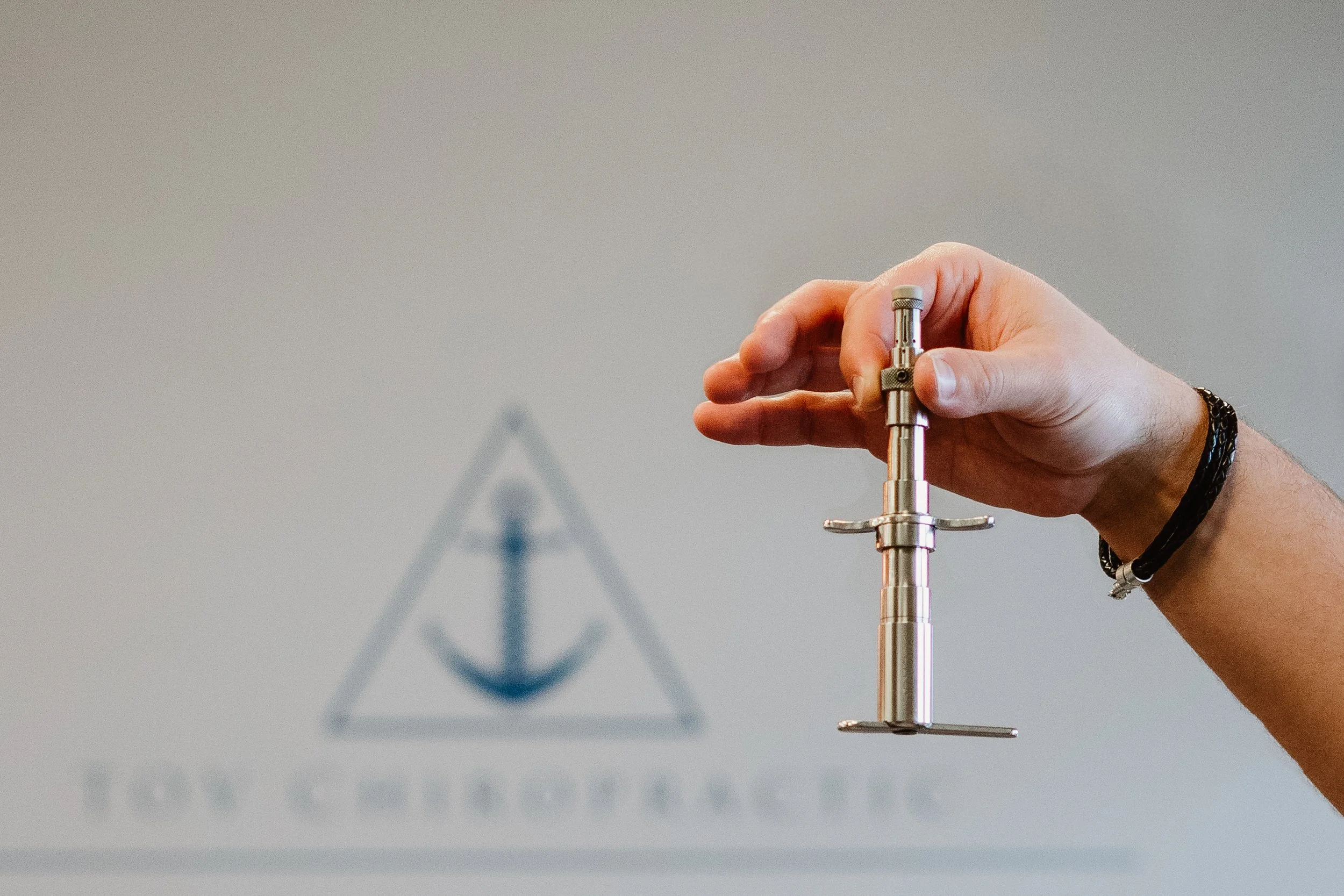
The evaluation itself is a careful look at how your nervous system is functioning. We're looking for signs of chronic sympathetic activation, autonomic imbalance, and structural patterns that may be contributing. The adjustments themselves are gentle — Torque Release Technique uses a small instrument that delivers precise, low-force input. There's no twisting, no popping. It looks and feels very different from the more forceful chiropractic care people often picture.
Care in a TTC context tends to be paced carefully. We coordinate around your cycle, around any medical treatments you're doing, and around what your body seems to be responding to. We are not trying to hurry your body. We're trying to give it consistent, gentle support so that it has the space to shift the underlying pattern.
We want to be honest about what this work is and isn't. It's not a fertility treatment. We do not treat infertility. We do not promise pregnancy. What we do is support the nervous system layer underneath the systems that govern fertility, and we take that work seriously because the physiology is real. Whether or not pregnancy follows depends on many factors, most of which are outside our scope.
What Patients Often Notice
The changes women describe in this stretch of care tend to arrive in a specific order, and it's worth naming, because the order matters.
They notice their sleep first. It gets deeper. They fall asleep more easily. The 3 a.m. wake-ups that were a fixture of their TTC anxiety start to become less frequent.
Then, often, their cycles begin to look different. Luteal phases lengthen. Spotting decreases. Their tracking apps start to line up with what their body is doing in ways they hadn't seen before.
They feel more like themselves. The two-week wait becomes more bearable — not because the wait becomes easier, but because their nervous system has more capacity to hold it.
And sometimes, pregnancy follows. We want to be careful about how we say this. We do not claim credit for these outcomes. We do not promise them. What we can say is that we've seen this pattern often enough that when it happens, it doesn't surprise us. A body whose nervous system has settled is a body doing its job better.
When it does happen, we adjust care accordingly — gentle prenatal chiropractic is a natural next chapter of this same work.
A Word About Your Partner
This conversation often centers on the person carrying the pregnancy, but fertility is a team endeavor, and the nervous system piece applies to both partners.
Male fertility is affected by chronic stress in similar ways. Cortisol can affect testosterone production. Sperm quality is sensitive to sustained stress states. A partner running his own chronically activated nervous system pattern brings that into the shared physiology of conception.
For couples who are ready, having both partners in this kind of care often makes sense. It's not a requirement. Many women come in on their own and see meaningful changes. But if your partner is open, and if the picture on his side includes chronic work stress, sleep issues, or a nervous system that's been running hot for a long time, it's worth mentioning. Nervous system regulation is not a solo project when you're both invested in the same outcome.
A First Visit at TOV
A first visit is the low-pressure place to start this. It's not a commitment to a treatment plan. It's a conversation, a careful evaluation, and an honest picture of where things are — followed by a clear input on whether our work makes sense for you at this stage.
We'll ask about your journey so far, look carefully at what your nervous system is doing, and tell you plainly whether we think we can help. If we don't think we're the right fit, we'll say so and point you toward what might make more sense.
For women in the TTC stretch, we've found that a first visit is often useful just for having someone name the pattern we've been describing, whether or not you move forward with care. Naming it — hearing that the exhaustion and the anxiety and the cycle patterns are connected, not separate — is sometimes the first real relief someone in this journey has had in months.
A common question we get, so worth answering: how long does care typically take before you'd expect to see anything? The honest answer is that it varies. Some women notice sleep and cycle shifts within the first few weeks. Others see the pattern release more slowly over two to three months. Bodies that have been running the alert pattern longest often take longest to settle — which isn't bad news, just information. We'll be honest with you at every step about what we're seeing and what we're not, so you always know where you actually stand.
You Are Not the Problem
If you take one thing from this post, take this. You are not the problem. Your body is not broken. Your fertility struggles are not evidence of some failing you can trace back to a decision you made or didn't make.
You are a person whose nervous system has been carrying a lot for a long time, and there is a real, physical layer of care that supports the systems that support fertility. That layer isn't a magic answer. It doesn't guarantee outcomes. What it does is honor what's actually happening in your body, and offer real support to a system that has been running too hard for too long.
If you're ready to explore that layer, a first visit at TOV Chiropractic is a calm place to start. You can book online or call us if you'd rather have a conversation first. We see women across Mankato and southern Minnesota in exactly this stretch of the journey. You are not alone, you are not the problem, and there is more support available to you than the standard fertility conversation tends to name.